
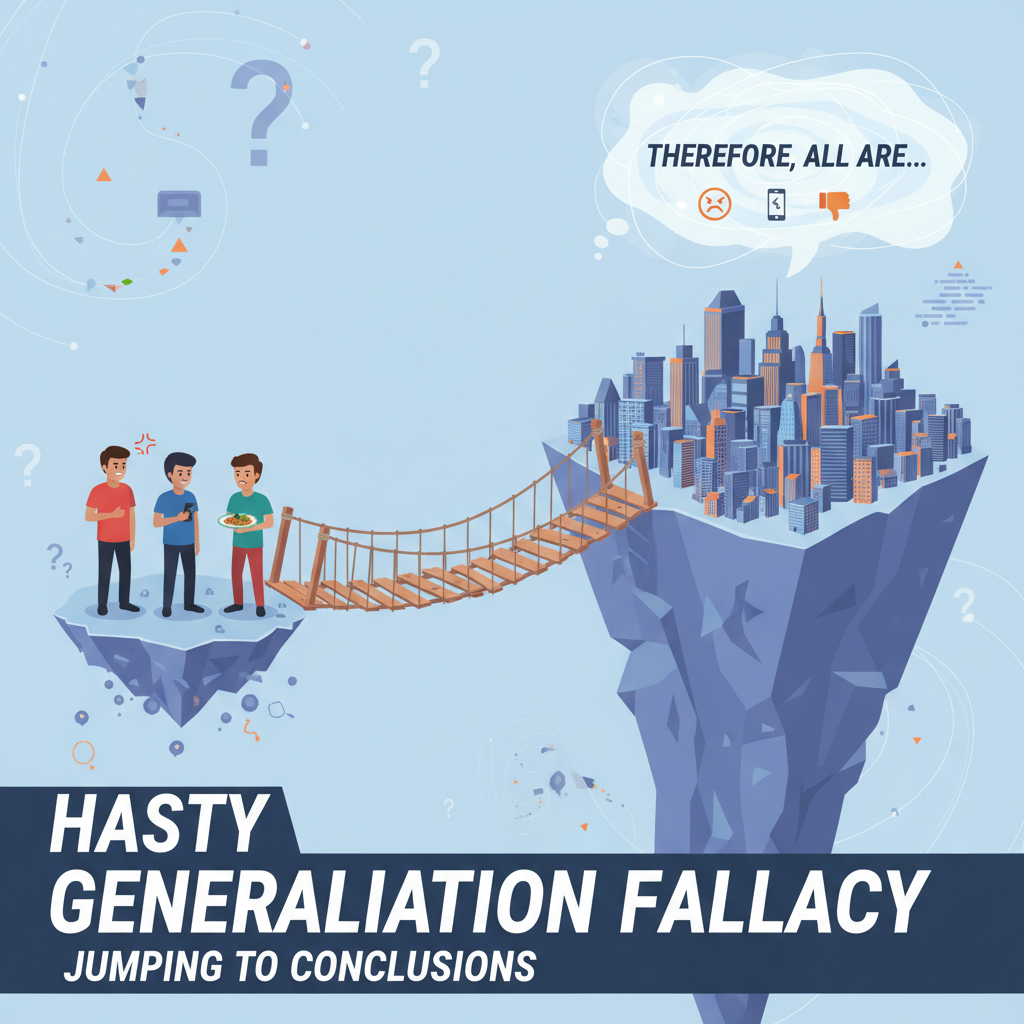
Have you ever met one rude person and thought everyone was rude? If yes, you may have made a hasty generalization fallacy. This mistake happens when someone makes a big claim from very little evidence.
The idea is simple. A person sees one or two examples and then creates a rule for a whole group. However, one example does not always tell us the full story.
For example, imagine that you visit a restaurant once. The food tastes bad. Then, you say, “This restaurant always serves bad food.” That conclusion may not be fair.
The hasty generalization fallacy can appear in daily talks, school discussions, social media, news, and even serious debates. Therefore, learning about it can help us think more clearly.
What Is a Hasty Generalization Fallacy?
A hasty generalization fallacy is a reasoning error. It happens when someone reaches a general conclusion from a small or weak sample.
In simple words, the person does not have enough evidence. Still, they make a strong statement. The evidence may be true, but it does not support such a large conclusion.
For example, someone may meet two unfriendly tourists from a country. Then, they might say that everyone from that country is unfriendly. That conclusion goes far beyond the evidence.
A good conclusion should match the amount of evidence available. If you have only one example, your claim should stay small. If you have strong evidence from many examples, your conclusion can become stronger.
The hasty generalization fallacy is also called a faulty generalization. It is a common type of informal logical fallacy.
Simple Hasty Generalization Fallacy Example
Here is an easy example.
A student gets a low grade on one math test. After that, the student says, “I am terrible at math.” This conclusion comes from one test.
The student may have been tired. Maybe the questions were difficult. Perhaps the student did not study enough. One test cannot fully measure someone’s ability.
Another example involves animals. Suppose a child gets scratched by one cat. The child then says, “All cats are dangerous.” That is another hasty generalization fallacy.
The child has one experience. Yet, the child applies that experience to every cat. Some cats may be friendly, calm, and safe around people.
Why Does Hasty Generalization Happen?
People often make quick judgments because the human brain likes simple answers. We naturally look for patterns.
Sometimes, quick thinking helps us. It saves time when we need to make a small decision. However, quick thinking can also lead to mistakes.
For example, one bad experience can stay in our memory. Later, we may remember that experience more strongly than many good ones.
Emotions also play a role. Anger, fear, and disappointment can make people jump to conclusions. Therefore, emotional situations often create weak generalizations.
Social media can make this problem worse. People often see short posts without full context. Then, they may form strong opinions from very limited information.
Common Signs of a Hasty Generalization Fallacy
There are several signs that can help you spot this fallacy.
First, look for words such as “all,” “none,” “always,” and “never.” These words often signal a very broad claim.
Next, ask how many examples support the statement. If the person has only one or two examples, the conclusion may be too large.
Also, check whether the examples represent the larger group. A small group may not accurately represent everyone.
Finally, ask whether other explanations exist. Sometimes, another reason can explain the event better than the general claim.
Hasty Generalization Fallacy in Everyday Life
The hasty generalization fallacy appears in ordinary conversations all the time. You may hear it without noticing.
Imagine someone buys a phone from a certain brand. The phone stops working after a week. The person says, “That company makes terrible phones.”
That statement may be too broad. The person has experience with only one phone.
Another person may visit a city during heavy rain. They might say, “It always rains here.” However, they may have visited on only one rainy day.
These examples show why careful thinking matters. One experience can teach us something, but it does not always prove a universal rule.
Hasty Generalization Fallacy in School
Students can also make this mistake at school.
For example, a student may fail one science quiz. Then, they say, “Science is impossible.” That statement comes from one difficult experience.
Instead, the student could say, “I found this science quiz difficult.” That statement is more accurate.
Teachers can also help students understand this difference. They can ask students to look at evidence before making broad claims.
This skill helps students in many subjects. It can improve writing, research, debates, and problem-solving.
Hasty Generalization Fallacy in Social Media
Social media provides many opportunities for generalization errors.
A person may see one negative comment from a group. Then, they may assume that everyone in that group thinks the same way.
Another person may see one bad news story about a place. Then, they may decide that the entire place is unsafe.
However, social media posts usually show only small pieces of information. They do not always represent the complete picture.
Therefore, it is wise to pause before sharing or repeating a broad claim. Check the source and look for more evidence first.
Hasty Generalization Fallacy in Advertising
Advertising can sometimes encourage broad thinking.
For example, an advertisement might show one person getting great results from a product. The message may suggest that everyone will get the same result.
One person’s experience does not prove that every customer will have the same experience.
This does not mean every advertisement uses a fallacy. Instead, it means we should examine the evidence carefully.
Ask questions before accepting a big claim. How many people were tested? What were the conditions? Who conducted the study?
Hasty Generalization Fallacy in News
News stories can also lead people toward generalizations.
Suppose a news report describes one crime committed by a person from a particular group. Some readers may then blame the entire group.
That is unfair reasoning. One person’s actions do not automatically represent millions of other people.
Good news analysis requires context. We should look at statistics, reliable reports, and larger patterns.
Therefore, readers should avoid making huge conclusions from one dramatic story.
Hasty Generalization Fallacy vs. Fair Generalization
Not every generalization is wrong.
A fair generalization uses enough evidence to support a reasonable conclusion. It also considers whether the evidence represents the larger group.
For example, a researcher may study thousands of people. The researcher may find a common pattern. That conclusion can be much stronger.
A hasty generalization fallacy, however, uses weak or limited evidence.
The difference is mainly about evidence. A good generalization has support. A hasty generalization jumps too quickly.
How to Avoid Hasty Generalization Fallacy
Avoiding this fallacy does not require advanced skills. A few simple habits can help.
First, slow down before making a broad claim. Give yourself time to think about the evidence.
Second, ask whether you have enough examples. One example is rarely enough to describe an entire group.
Third, look for different examples. Try to find evidence that does not match your first opinion.
Finally, use careful language. Instead of saying “everyone,” you can say “some people.” This makes your statement more accurate.
Ask for More Evidence
Evidence is one of the best tools against the hasty generalization fallacy.
When someone makes a broad claim, ask a simple question: “What evidence supports that?”
This question does not need to sound rude. It simply encourages better thinking.
You can also ask, “How many examples do you have?” This helps you understand whether the claim comes from a large sample or a tiny one.
The goal is not to win an argument. The goal is to reach a more accurate conclusion.
Use Smaller and More Accurate Claims
Sometimes, changing the wording can fix the problem.
Instead of saying, “All teenagers are lazy,” you could say, “Some teenagers may struggle with motivation.”
The second statement is more careful. It does not claim that every teenager behaves the same way.
Similarly, instead of saying, “This store is always bad,” you could say, “I had a bad experience at this store.”
Small changes can make a big difference. They help your words match your evidence.
Look at the Sample Size
Sample size matters when making general conclusions.
If you ask one person a question, you learn about one person. You cannot automatically apply that answer to millions of people.
If you ask 10,000 people, you have more information. Still, the way you choose those people also matters.
For example, asking only your friends may give you a biased sample. Your friends may share similar interests and backgrounds.
Therefore, both sample size and sample quality matter when avoiding a hasty generalization fallacy.
Consider Different Examples
Another useful habit is to search for examples that challenge your belief.
Suppose you think all dogs are aggressive. You might remember one scary dog.
However, you could also look at friendly family dogs, trained service dogs, and calm pets. These examples can challenge your original idea.
This process helps you avoid thinking in extremes.
It also teaches an important lesson. A single example can be real without proving a universal rule.
Hasty Generalization Fallacy in Arguments
Arguments often contain generalizations.
Imagine two people discussing customer service. One person says, “I had a rude cashier, so workers at that store are rude.”
The other person could ask, “Was that one cashier representative of every worker?”
That question points directly to the problem.
The first person may have had a real bad experience. However, the conclusion still needs more evidence.
Examples of Hasty Generalization Fallacy
Here are several simple examples:
- “I met one rude student, so all students are rude.”
- “One dog bit me, so all dogs are dangerous.”
- “I failed one test, so I am bad at school.”
- “One movie from that director was boring, so all their movies are boring.”
- “One customer complained, so everyone hates the product.”
- “I visited once and it rained, so it always rains there.”
- “One person lied to me, so nobody can be trusted.”
Each statement moves from a small example to a very large conclusion.
That jump is the key feature of the hasty generalization fallacy.
Why One Example Is Not Enough
One example can be useful. However, it usually cannot prove a broad rule.
Imagine finding one red apple in a basket. You cannot say every apple in the world is red.
You need more information. You may need to look at many apples from different baskets and places.
The same idea works with people, products, events, and opinions. A larger and fairer sample usually gives a better picture.
Difference Between Hasty Generalization and Stereotyping
These ideas can sometimes overlap, but they are not exactly the same.
A stereotype is a fixed belief about a group. A hasty generalization fallacy is a reasoning error caused by making a broad conclusion from limited evidence.
For example, someone may meet two people from a group and decide that everyone in the group acts the same way.
That reasoning contains a hasty generalization. It may also create or support a stereotype.
Therefore, careful thinking can help reduce both problems.
Difference Between Hasty Generalization and Anecdotal Evidence
Anecdotal evidence comes from personal stories or individual experiences.
Personal stories can be meaningful. They can show what happened to one person.
However, one story does not always prove a larger claim.
For example, someone may say, “My friend used this product and loved it, so this product works for everyone.”
That is not strong evidence for everyone. It is simply one person’s experience.
How Teachers Can Explain Hasty Generalization
Teachers can explain the idea with simple examples.
They might ask students to imagine meeting one unfriendly person. Then, they can ask whether that person represents everyone.
This activity can help students see the problem quickly.
Teachers can also use classroom surveys. Students can compare results from five people with results from the whole class.
Such activities make logical thinking easier and more practical.
How Parents Can Teach Better Reasoning
Parents can teach this skill during everyday conversations.
If a child says, “All my classmates are mean,” a parent can gently ask, “Did every classmate act that way?”
This question encourages the child to think about evidence.
Parents can also share their own examples. They can show how one bad experience does not always describe everyone.
Over time, children can learn to pause before making broad statements.
How Writers Can Avoid Hasty Generalizations
Writers should be especially careful with broad claims.
When writing an article, essay, or report, avoid words such as “everyone” unless the evidence truly supports them.
Instead, use accurate words such as “some,” “many,” “often,” or “in some cases.”
Also, support important claims with reliable evidence. Research can make an argument stronger.
This approach makes writing more trustworthy. It also helps readers understand the limits of the information.
How to Correct a Hasty Generalization
If you notice that you made a hasty generalization fallacy, you can correct it.
First, admit that your evidence was limited. There is no shame in changing your mind.
Next, make your statement smaller. Describe what you actually know.
For example, change “All restaurants here are bad” to “I had a bad meal at one restaurant.”
That new statement is based on your actual experience. It does not go beyond the evidence.
Why Critical Thinking Matters
Critical thinking helps us examine ideas before accepting them.
It encourages us to ask questions. It also helps us separate facts from opinions.
The hasty generalization fallacy shows why critical thinking matters. Without it, we may believe claims that have little support.
Critical thinking does not mean doubting everything. Instead, it means checking whether a conclusion fits the evidence.
This skill can help at school, work, online, and in daily conversations.
Quick Checklist for Spotting the Fallacy
Use this checklist when you hear a broad claim:
- What evidence supports the claim?
- How many examples are available?
- Are the examples representative?
- Could another explanation exist?
- Does the conclusion go beyond the evidence?
- Are words like “always” or “everyone” being used?
- Is the claim based mostly on one personal story?
If the evidence is weak, be careful.
The speaker may be using a hasty generalization fallacy without realizing it.
Five Small FAQs About Hasty Generalization Fallacy
What is a hasty generalization fallacy?
A hasty generalization fallacy happens when someone makes a broad conclusion from too little evidence.
Is one example enough?
Usually, no. One example can show that something happened, but it normally cannot prove that the same thing happens everywhere.
Is every generalization a fallacy?
No. A generalization can be reasonable when it uses enough relevant evidence.
How can I avoid this fallacy?
Slow down, check more examples, and make sure your conclusion matches your evidence.
Why is this fallacy common?
People often make quick judgments. Emotions, personal experiences, and limited information can also lead to this mistake.
Conclusion
The hasty generalization fallacy is a common reasoning mistake. It happens when someone uses a small amount of evidence to make a large claim.
The good news is that this mistake is easy to understand. You simply need to slow down and examine the evidence.
Remember that one experience does not always represent a whole group. One person does not represent everyone. One event does not always show a complete pattern.
Therefore, ask questions before making broad conclusions. Look for more examples. Check whether your evidence is strong and fair.
By doing this, you can avoid the hasty generalization fallacy and become a better thinker, writer, student, and decision-maker.