
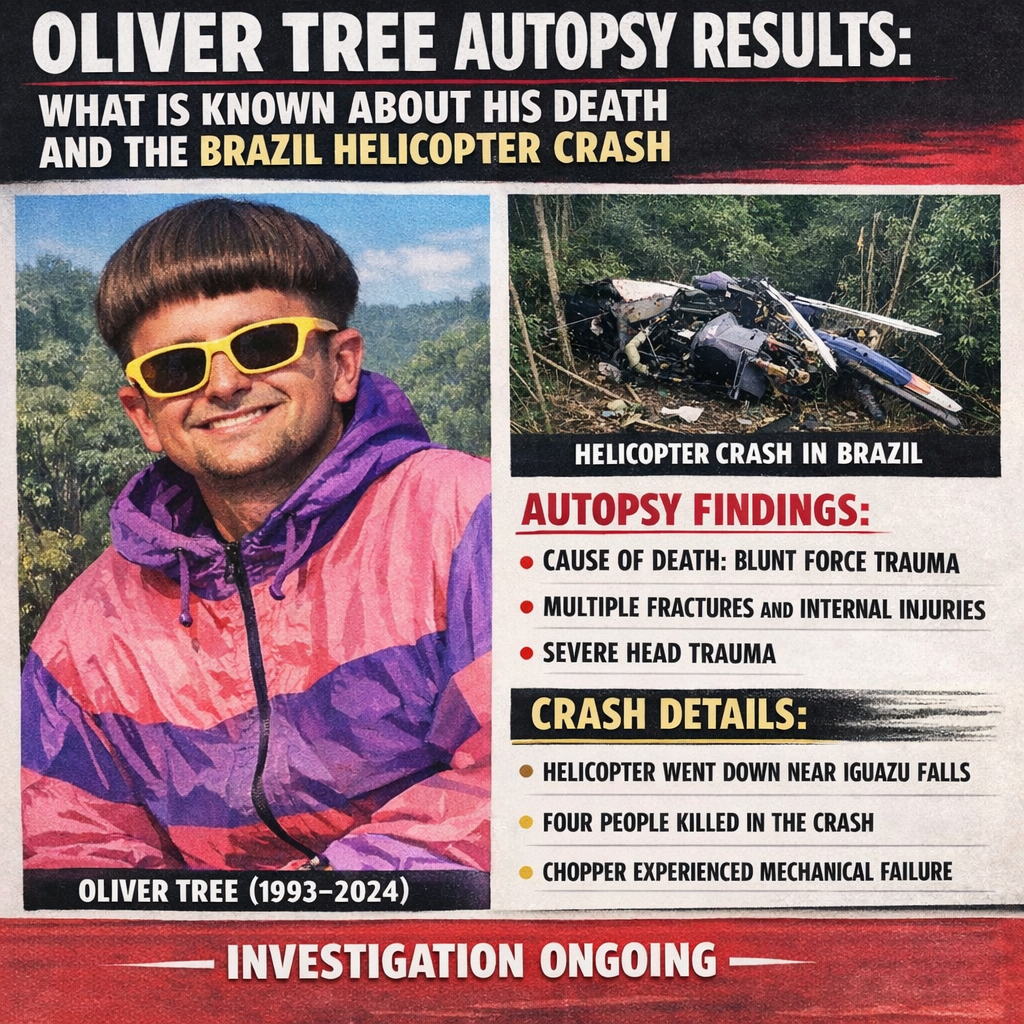
Oliver Tree was an American singer, songwriter, producer, comedian, and internet personality known for his unusual style and creative music videos. His career grew quickly through songs such as “Alien Boy,” “Hurt,” “Life Goes On,” and “Miss You.” He also became known for his bowl haircut, colorful outfits, strange humor, and dramatic online personality.
In June 2026, news about Oliver Tree changed suddenly. The artist died in a helicopter collision in Rio de Janeiro, Brazil, at the age of 32. The accident involved two helicopters and killed six people. His death created a large amount of interest online, including searches for Oliver Tree autopsy results, Oliver Tree cause of death, Oliver Tree death, Oliver Tree helicopter crash, and Oliver Tree forensic report.
There is an important difference between what is confirmed and what is only discussed online. Authorities confirmed Oliver Tree’s death and later identified his remains through forensic examination. However, a detailed public autopsy report containing private medical findings, toxicology results, or a complete list of injuries has not been made publicly available in the reliable sources reviewed for this article.
Therefore, readers should be careful when they see websites or social media posts claiming to reveal exact Oliver Tree autopsy results. Some details may be guesses, recycled information, or unsupported claims. The confirmed story is already serious enough without adding information that authorities have not released.
Oliver Tree Death and the June 2026 Helicopter Crash
Oliver Tree died on June 14, 2026, during a helicopter accident in Rio de Janeiro, Brazil. Two helicopters collided in the air over the western part of the city. The crash resulted in the deaths of all six people involved.
According to reporting from major news organizations, Tree was traveling in one of the helicopters with other passengers. The other helicopter also had a pilot on board. The accident happened in the Recreio dos Bandeirantes area of Rio de Janeiro. One helicopter crashed into the parking area of a car dealership, where a fire followed the impact.
The accident immediately became international news because Oliver Tree had a large global fan base. He had been traveling as part of his world tour and had recently performed in South America. His death came only a short time after the release of his 2026 album, Love You Madly Hate You Badly.
At first, authorities had to work to identify all of the victims. This is important when discussing Oliver Tree autopsy results because identification and autopsy are not exactly the same thing. A forensic team may use different methods to identify a person after a serious accident.
Early reports said Tree was listed as a passenger on the helicopter. However, his identity was not immediately confirmed because of the condition of the victims following the crash. Brazilian authorities later completed the identification process.
The official identification process provided the confirmation that Oliver Tree was among the people who died. Later reports from CNN Brasil stated that the Rio de Janeiro forensic medical institute identified Tree using dental analysis.
What Are the Confirmed Oliver Tree Autopsy Results?
The most important point about the Oliver Tree autopsy results is that there is no widely available detailed public autopsy document that provides every medical finding.
Several online pages may use the phrase “Oliver Tree autopsy results” in their titles. However, a title alone does not prove that an official autopsy report has been published. Readers should look for a primary source from the responsible forensic authority or a reputable news organization that directly cites such a document.
What is publicly confirmed is that forensic authorities identified Oliver Tree after the helicopter accident. CNN Brasil reported that his identification was completed through examination of his dental arch. This was part of the forensic identification process used after the crash.
That information should not be confused with a full public autopsy report. Identification tells authorities who a victim is. An autopsy can involve a much broader medical examination. It can document injuries, examine organs, collect samples, and potentially provide information about the cause or circumstances of death.
As of the information reviewed for this article, detailed findings such as a complete injury list, toxicology results, blood analysis, or other private medical details have not been reliably published as an official public Oliver Tree autopsy report.
This distinction matters because internet searches can quickly turn small pieces of information into much larger stories. A website may claim that it knows exactly what happened inside a victim’s body without showing a credible source. Such claims should not automatically be accepted.
The confirmed cause of death can be described more generally as the fatal helicopter crash. The exact forensic details of Oliver Tree’s injuries have not been publicly established through a detailed report that reliable sources have made available.
How Was Oliver Tree Identified After the Crash?
Forensic identification became an important part of the investigation because the helicopter collision was extremely serious. The condition of victims after a major aviation accident can make ordinary visual identification difficult or impossible.
CNN Brasil reported on June 15 that forensic specialists at the Afrânio Peixoto Institute of Legal Medicine in Rio de Janeiro were collecting genetic material to help identify the remaining unidentified victim. At that point, Tree was the last victim whose identity had not yet been officially confirmed.
On June 16, CNN Brasil reported that all six victims had been identified. Tree was the final victim to be formally identified. According to that report, the identification was completed using dental analysis.
Dental identification is a recognized forensic method. Investigators can compare dental structures with previous dental records. This can be useful when other forms of identification are difficult.
The identification of Oliver Tree therefore provided an official answer to an important question surrounding the accident. It confirmed that the artist was one of the people who died.
Some online discussions have confused this process with the publication of an autopsy report. They are different things. The identification confirmed the victim’s identity, while the wider investigation examined the circumstances of the helicopter collision.
What Caused Oliver Tree’s Death?
Oliver Tree’s death occurred because he was aboard a helicopter involved in the fatal midair collision in Rio de Janeiro.
Two helicopters collided on June 14, 2026. The accident killed six people. Early reports stated that authorities were investigating how the collision occurred. At the time, officials had not completed the full investigation into the cause.
Some early reports discussed the possibility of human error. However, it is important to separate an early investigative indication from a final accident determination. Aviation investigations can take time because investigators must examine aircraft remains, flight paths, communications, weather, operating procedures, and other evidence.
A preliminary report later provided more information about the flight paths of the helicopters. CNN Brasil reported that a preliminary CENIPA investigation found that the helicopter carrying Tree was not detected by the relevant radar systems during its flight. The other helicopter had portions of its flight recorded by radar.
The report also described similarities between the planned routes of the two helicopters. Their paths became particularly important around a section where the aircraft were operating in the same general corridor and at coinciding flight levels.
However, an important limitation remains. A preliminary aviation investigation is not the same thing as a final judicial or forensic conclusion about individual responsibility. CENIPA’s role is to investigate aviation safety and contributing factors rather than simply assign blame.
For this reason, articles about Oliver Tree’s cause of death should avoid presenting an unconfirmed explanation as a final fact.
What Did the Preliminary Investigation Reveal?
The preliminary investigation added important details about the circumstances surrounding the accident.
According to CNN Brasil’s reporting on the preliminary CENIPA findings, the helicopter carrying Oliver Tree had the registration PP-MAC. The aircraft was traveling from Jacarepaguá toward Angra dos Reis. The other helicopter, registered as PR-DJJ, was traveling from Santos Dumont toward Guaratiba.
The two helicopters had planned routes that overlapped in an important area. The investigation found that their paths became critical around a location referred to as Tachas. Both aircraft were using helicopter routes and had coinciding flight levels in that area.
The preliminary information also indicated that the PR-DJJ helicopter had GPS data that placed it at around 800 feet shortly before the collision. The collision occurred between the Tachas and Piabas positions.
Weather conditions were another factor considered by investigators. CNN Brasil reported that visibility was greater than 10 kilometers. This meant that the weather itself did not appear to create extremely poor visibility conditions.
Communication is also an important part of the investigation. The accident occurred in Class G airspace, where pilots use self-coordination through an appropriate frequency. According to the preliminary investigation, the frequency was not monitored by air traffic control agencies, meaning there was no official recording of the conversations between the crews before the collision.
The helicopters also did not have flight data recorders or cockpit voice recorders because those devices were not required for the aircraft models involved.
These facts help explain why investigators needed to examine several different sources of evidence. Without a conventional cockpit voice recording or complete flight-data recording from both helicopters, investigators have to rely on other evidence.
Why There Is Confusion About Oliver Tree Autopsy Results
Searches for Oliver Tree autopsy results became popular because fans wanted more information after his sudden death.
When a famous person dies unexpectedly, people often search for the cause of death, autopsy report, final moments, funeral details, family statements, and other information. That interest can also create an environment where inaccurate claims spread quickly.
The Oliver Tree case is especially sensitive because the accident involved a serious helicopter collision. Graphic descriptions and unverified claims can spread much faster than verified information.
There was also misinformation involving videos of the accident. Fact-checking by AFP found that an old helicopter collision video from Malaysia was falsely connected to the Brazil crash. Other unrelated crash footage also circulated online.
Snopes-related reporting also documented the problem of mislabeled videos. Some footage connected to the Rio crash was genuine, while other videos shared online actually came from separate aviation accidents in other countries and years.
This is a useful lesson when researching Oliver Tree autopsy results. A video, screenshot, social media post, or website headline is not automatically evidence.
Reliable information should be connected to an official authority, a direct statement, a court document, a forensic record, or a reputable news report that clearly identifies its source.
Oliver Tree’s Final Album Before His Death
Oliver Tree’s death happened only weeks after the release of his fourth major studio album, Love You Madly Hate You Badly.
Apple Music lists the album as a 17-track release that arrived on April 24, 2026. The album runs for about 47 minutes and is classified in the alternative genre.
The timing of the album made his death particularly shocking for fans. Tree had been active professionally and was traveling internationally. His death was not the result of a long public illness or a previously announced retirement.
His final album also became part of the way fans remembered him. Music that had been released only weeks before his death suddenly carried a different meaning for listeners.
Songs associated with the album include “Superhero,” “Joyride,” “Flowers,” “Deep End,” and “Crazy.” His music throughout his career often mixed alternative pop, electronic sounds, humor, unusual visuals, and character-based performances.
The album’s release also demonstrates why reports describing Oliver Tree as having disappeared before his death can be misleading. He was actively creating music and preparing for international performances in 2026.
His death happened while he was still involved in a major period of his artistic career.
Oliver Tree’s Music Career and Public Image
Oliver Tree Nickell became widely known because he did more than simply release songs. He created a recognizable visual identity around his music.
His bowl haircut, oversized clothing, sunglasses, unusual interviews, comedy, and exaggerated performances helped make him highly recognizable. His online presence also played a major role in his popularity.
Songs such as “When I’m Down,” “Alien Boy,” “Hurt,” “Life Goes On,” and “Miss You” helped build his international audience. His work crossed several styles, including alternative pop, electronic music, indie rock, and other modern sounds.
His public image was intentionally unusual. Tree often used comedy and absurd situations to promote his music. That approach made it difficult for some new viewers to understand where the character ended and the real person began.
Despite the humorous side of his public identity, his music often included serious themes. His songs explored relationships, personal experiences, frustration, loneliness, identity, and emotional conflict.
His career also included collaborations and performances with other artists. By 2026, he had established himself as a recognizable internet-era musician whose work reached audiences far beyond traditional music channels.
That background is important when discussing his death because the Oliver Tree autopsy results search is not just about a forensic question. It also reflects how quickly fans searched for reliable information about someone whose career was strongly connected to the internet.
What Happened to the Other People in the Helicopter Crash?
Oliver Tree was not the only person who died in the June 14 accident.
The helicopter carrying Tree also carried other passengers. The second helicopter had its pilot on board. In total, six people died.
News reports identified the victims as Oliver Tree, Argentine content creator Gaspar Prim, Argentine filmmaker Lucas Vignale, Brazilian music producer Lucas Brito, and pilots Charles Marsillac and Alexandre Souza.
The loss affected multiple communities. Tree had an international audience, while Gaspar Prim had a large following in Argentina. The Brazilian victims were also connected to the local aviation and entertainment communities.
The accident therefore became more than a celebrity death story. It was a major aviation tragedy involving six people.
This is another reason that articles about the crash should avoid focusing only on Oliver Tree. Doing so can leave out the other victims and reduce a complex tragedy to a single celebrity story.
Did Authorities Release Toxicology Results?
One of the most common questions surrounding celebrity autopsy searches concerns toxicology.
Toxicology testing can examine biological samples for alcohol, medications, drugs, poisons, and other substances. However, not every toxicology result becomes public.
In the case of Oliver Tree, reliable publicly available reporting reviewed for this article does not provide a verified detailed toxicology report that establishes specific substances in his system.
Therefore, claims about alcohol, drugs, medications, or other substances should not be repeated as confirmed facts unless they are supported by an official document or a reputable source directly reporting those findings.
This point is particularly important because online articles sometimes use the phrase “autopsy results” even when they do not possess an actual autopsy document.
Readers should therefore be skeptical of any page that provides very specific medical or toxicology claims without identifying the official source.
There is no need to fill information gaps with speculation. The confirmed facts already establish that Oliver Tree died in a helicopter collision in Brazil and that forensic authorities identified him after the accident.
Was Oliver Tree’s Body Identified by DNA?
DNA was part of the early forensic process surrounding the accident, but the final identification reported by CNN Brasil was completed through dental analysis.
On June 15, Brazilian forensic specialists were collecting genetic material for comparison because Tree was still the unidentified foreign victim.
The following day, CNN Brasil reported that the forensic institute had identified Tree through examination of his dental arch.
This means that readers should be careful with articles claiming that DNA alone was the final identification method. The publicly reported final identification method was dental analysis.
Forensic identification can involve multiple techniques. Investigators may compare fingerprints, dental records, DNA, medical information, personal effects, or other evidence depending on the circumstances.
The goal is to establish identity with a reliable level of certainty.
In Tree’s case, the identification process eventually confirmed that he was among the six victims of the helicopter crash.
What Happened to Oliver Tree’s Remains?
Following the forensic identification process in Brazil, arrangements were made for Oliver Tree’s remains to return to the United States.
AFP’s fact-checking report noted that NBC News had reported Tree’s body was returned to California on June 22.
The return of his remains allowed his family and loved ones to proceed with memorial arrangements.
A celebration of life was later held in July. The event brought together people who knew Tree personally and professionally, along with members of his wider creative community. His music and career were remembered during the event.
A YouTube listing from Oliver Tree’s official artist channel also promoted a celebration of life in Santa Cruz, with proceeds connected to a grant supporting young artists.
These events became part of the public remembrance of Tree after his death.
Oliver Tree Memorial and Legacy
After his death, friends, fans, and fellow artists shared tributes to Oliver Tree.
Warner Music Group published a statement on June 15 expressing sadness over his death and describing him as an inventive and original artist. The statement came from Atlantic Records and Warner Chappell Music.
Other artists also remembered him publicly. His unusual personality made him easy to recognize, but his music gave him a much deeper connection with fans.
His work had a strong visual component. Music videos, costumes, comedy, and online performances were often part of the same creative world.
That made Oliver Tree different from artists who rely mainly on traditional album releases. He understood the power of internet culture and used it as part of his artistic identity.
His death also left unfinished creative work. T-Pain later played an unreleased collaboration involving Oliver Tree during an Electric Forest performance, helping fans hear material that had been created before Tree’s death.
The existence of unreleased music means that Tree’s artistic work may continue to appear after his death. However, future releases should be distinguished from material that he personally released while alive.
Why the Final Cause of the Crash Matters
The cause of the helicopter collision remains an important part of the broader investigation.
For Tree’s fans, the immediate question is often “What happened to Oliver Tree?” The answer is that he died in the helicopter collision. But aviation investigators must answer a much larger set of questions.
They need to understand how the aircraft were operating, what their planned routes were, how they were positioned, what communication occurred, what radar information existed, what the pilots could see, and whether technical or operational factors contributed.
The preliminary investigation already identified several important circumstances, including coinciding routes and flight levels and differences in radar tracking between the two helicopters.
The absence of traditional cockpit voice and flight data recorders also limits the amount of direct information available from the aircraft themselves.
Investigators can still use other sources. These may include GPS devices, image systems, aircraft wreckage, witness information, flight plans, radar data, weather information, and other evidence.
Aviation investigations are designed to understand accidents and identify contributing factors so that similar accidents can potentially be prevented.
Therefore, the final explanation may involve several contributing factors rather than one simple cause.
Oliver Tree Autopsy Results and Online Rumors
The internet has created a major problem for people searching for information after a celebrity death.
A rumor can begin with a social media post and then appear on several websites. Once multiple pages repeat the same statement, it may look legitimate even if none of the pages has an original source.
This can happen with autopsy claims.
For example, a website may publish a detailed list of injuries and label it “Oliver Tree autopsy results.” If the page does not link to an official forensic report, readers cannot assume those details are genuine.
The same issue applies to videos. Fact-checking organizations documented how unrelated helicopter crash footage was shared as though it showed the 2026 Rio accident.
This shows why source checking is essential.
A reliable article should identify where its information comes from. If a claim involves private medical information, the source should be especially strong.
The safest approach is to focus on information confirmed by Brazilian authorities, aviation investigators, Tree’s representatives, major news organizations, and official memorial announcements.
What We Know and What We Do Not Know
There are several facts that can be stated with confidence.
Oliver Tree died on June 14, 2026, at the age of 32. He died in a helicopter collision in Rio de Janeiro, Brazil. Six people died in the accident. His identity was eventually confirmed through forensic examination, with dental analysis reported as the method used for his final identification.
Aviation investigators examined the accident and released preliminary information about the helicopters’ routes, radar detection, flight levels, communication environment, and other circumstances. The investigation was not simply about determining the identity of the victims. It was also about understanding how the collision happened.
However, some information remains unavailable to the public.
A detailed official autopsy report with a complete list of injuries has not been established through the reliable public sources reviewed for this article. Publicly verified toxicology findings have also not been identified.
Likewise, readers should not treat social media claims about specific substances, medical conditions, or private forensic findings as facts without a credible primary source.
This distinction gives a more accurate answer to the search query “Oliver Tree autopsy results.”
Frequently Asked Questions About Oliver Tree Autopsy Results
What happened to Oliver Tree?
Oliver Tree died in a helicopter collision in Rio de Janeiro, Brazil, on June 14, 2026. He was 32 years old. The accident killed six people.
What was Oliver Tree’s cause of death?
His death occurred as a result of the fatal helicopter collision in Brazil. The broader aviation investigation examined the circumstances and possible contributing factors surrounding the crash.
Were Oliver Tree’s remains identified?
Yes. Brazilian forensic authorities identified Oliver Tree as the final unidentified victim of the accident. CNN Brasil reported that dental analysis was used to complete the identification.
Were Oliver Tree’s autopsy results released?
A detailed public autopsy report containing complete medical findings has not been established in the reliable sources reviewed for this article. Claims online should therefore be treated cautiously unless supported by an official source.
Was Oliver Tree’s death caused by drugs?
There is no reliable public evidence reviewed here that establishes a drug-related cause of death. The confirmed event was the helicopter collision. Specific toxicology claims should not be treated as facts without an official report.
Was Oliver Tree on tour when he died?
Yes. He was in Brazil during an international tour. Reports said he had recently performed in South America before the June 14 accident.
What was Oliver Tree’s last album?
His 2026 album was Love You Madly Hate You Badly. Apple Music lists it as a 17-song album released on April 24, 2026.
How many people died in the helicopter crash?
Six people died in the June 14, 2026 helicopter collision in Rio de Janeiro. Oliver Tree was one of the victims.
Was the helicopter crash investigated?
Yes. Brazilian authorities investigated the accident, while CENIPA examined aviation-related circumstances and contributing factors. A preliminary report later provided additional information about flight paths, radar tracking, and other details.
Conclusion
The search for Oliver Tree autopsy results has attracted significant attention because his death was sudden and unexpected. However, the available evidence shows that readers should separate confirmed facts from unsupported online claims.
Oliver Tree died at the age of 32 on June 14, 2026, when two helicopters collided over Rio de Janeiro. Six people lost their lives in the accident. His identity was initially difficult to confirm, but Brazilian forensic authorities later identified him through dental analysis.
The aviation investigation provided additional information about the circumstances of the accident. Preliminary findings discussed overlapping routes, flight levels, radar tracking, communication conditions, and the lack of traditional flight recorders on the aircraft. The investigation continued to examine the factors that contributed to the collision.
What has not been reliably established in public reporting is a complete, detailed Oliver Tree autopsy report containing every medical finding or toxicology result. Therefore, websites claiming to reveal exact private autopsy details should be approached carefully unless they provide a credible official source.
Oliver Tree’s legacy is ultimately much larger than the circumstances of his death. He built a distinctive career through music, comedy, visual art, internet culture, and unusual performances. His songs reached millions of listeners, and his 2026 album was released only weeks before the accident.
For fans researching Oliver Tree’s death, the most responsible approach is to rely on confirmed information and avoid repeating unverified details. The facts surrounding his final days are already documented through reputable reporting, while some private forensic information remains unavailable. As new official information becomes available, it should be evaluated against primary sources rather than online rumors.