
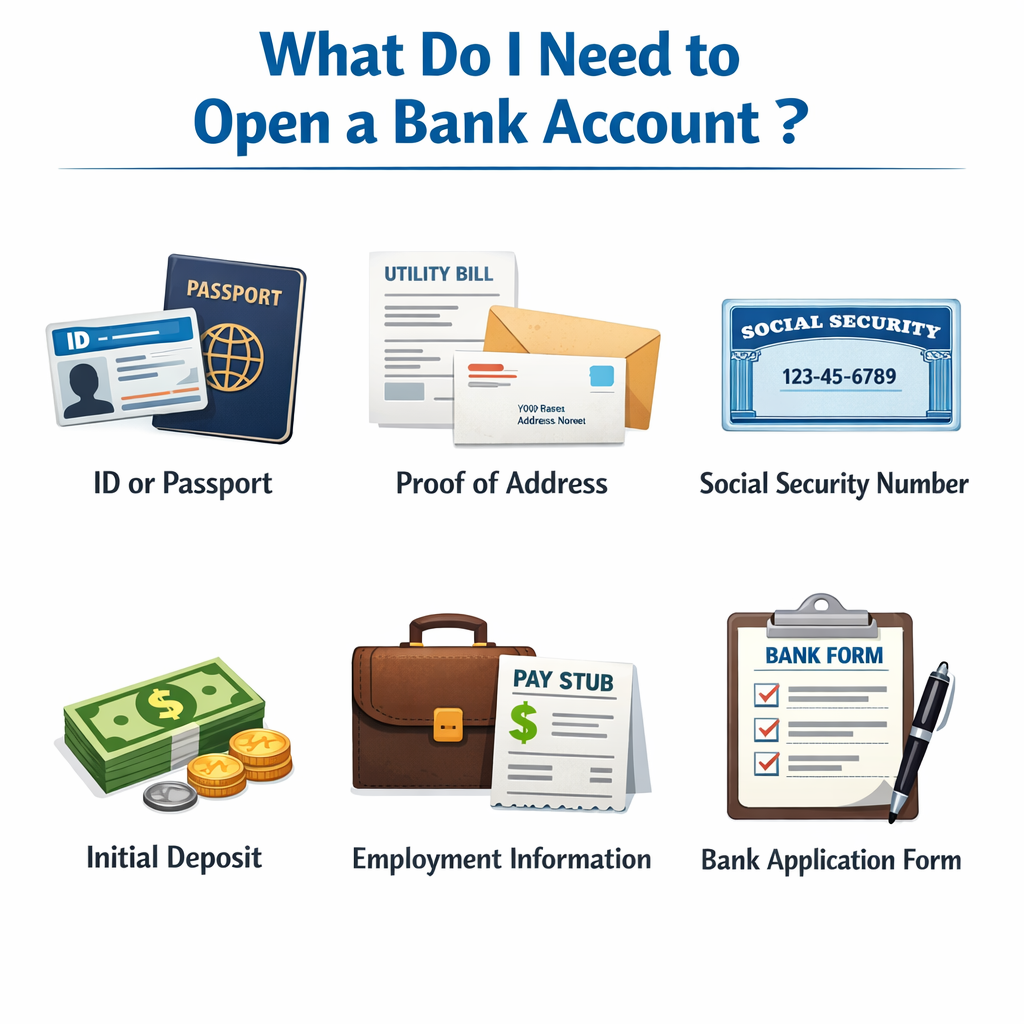
Opening a bank account is an important step toward managing your money. A bank account can help you receive your salary, pay bills, save money, use a debit card, and make everyday payments. It can also give you a safer place to keep your money than carrying large amounts of cash.
Many people wonder, “What do I need to open a bank account?” The answer depends on the bank, the type of account, and your personal situation. However, most banks ask for basic information such as your name, date of birth, address, and identification number. You may also need a government-issued ID and money for an initial deposit.
Some banks allow you to open an account online. Others may ask you to visit a branch. The documents can also be different for citizens, immigrants, students, minors, and people opening joint accounts.
This guide explains the common requirements in simple terms. It also explains what documents you may need, how much money you need, how online account opening works, and what you should check before choosing a bank.
What Information Do You Need to Open a Bank Account?
The first thing a bank needs is information that helps identify you. In the United States, banks generally collect your name, date of birth, address, and identification number when you open an account. These requirements are part of the bank’s customer identification procedures.
Your full legal name should normally match the identification documents you provide. The bank may also ask for your current residential address. If you recently moved, the bank may request additional proof that you live at the address you provide.
You may also need to provide a Social Security number or another acceptable taxpayer or identification number. Some institutions may accept an Individual Taxpayer Identification Number, passport number, or another government-issued identification number depending on the account and the bank’s policies.
Banks may also ask for your phone number and email address. These details can help the bank contact you about your account, send security alerts, and complete online verification.
If you apply online, the bank may ask you to enter this information into an application. It may also ask additional questions to confirm your identity. If the bank cannot verify your information electronically, you may need to visit a branch or contact the bank.
What Identification Do You Need to Open a Bank Account?
Identification is one of the most important requirements when opening a bank account. Banks need to make sure the person opening the account is really the person they claim to be.
A common form of identification is a driver’s license. A state identification card can also work if you do not have a driver’s license. A U.S. passport is another common option. Military identification may also be accepted by some financial institutions.
Some banks accept foreign passports and certain consular identification documents. However, every bank can have its own requirements. If you are not a U.S. citizen, it is useful to contact the bank before visiting a branch and ask which documents it accepts.
Your identification should usually be current and readable. If your name has changed, you may need additional documents showing the legal name change.
Some banks may ask for more than one form of identification. For example, a bank may accept a driver’s license as the primary ID and then ask for another document such as a Social Security card, birth certificate, or bill showing your name and address. Requirements are not identical at every institution.
If you are unsure whether your ID is acceptable, do not assume it will work. Check the bank’s requirements first. This can save you a trip to the branch and prevent delays.
Do You Need Proof of Address to Open a Bank Account?
Proof of address is another common requirement. A bank may ask for proof of your current address if the address on your identification does not match the address you provide.
A recent utility bill can sometimes be used as proof of address. A lease or other acceptable document may also work, depending on the bank. The Federal Deposit Insurance Corporation explains that a customer may be asked for proof of a current address, such as a recent bill or a copy of a lease, when the address does not match the identification document.
The exact documents accepted as proof of address vary between banks. One bank might accept a utility bill, while another could accept a lease, government document, or another official piece of mail.
The document generally needs to show your name and current address. It should also be recent enough to meet the bank’s requirements.
People who have recently moved may face extra verification steps. Online banks can have particular difficulty verifying an address electronically when a customer has recently moved. In that situation, the bank may ask the person to visit a branch or provide additional information.
Therefore, if you have recently changed your address, prepare more than one document if possible.
How Much Money Do You Need to Open a Bank Account?
You may need money for an initial deposit. However, there is no single amount that applies to every bank account.
The Consumer Financial Protection Bureau has explained that an initial deposit for some checking or savings accounts may commonly fall between $25 and $100. However, some banks and credit unions do not require an opening deposit, while others may allow accounts to be opened with a smaller amount.
This is why you should check the specific account’s terms before applying. An account may have a low opening deposit but still require you to maintain a certain balance to avoid a monthly fee.
For example, an account could allow you to open it with $25 but require you to keep a certain balance to avoid a monthly maintenance charge. The opening deposit and minimum balance are two different things.
You should also check whether there are fees for ATM use, overdrafts, transfers, paper statements, or other services. Understanding these costs before opening an account can help you avoid unexpected charges.
Do You Need a Social Security Number to Open a Bank Account?
A Social Security number is commonly requested when opening a bank account in the United States. However, the exact identification requirements can depend on the bank and the type of account.
The bank generally needs an identification number as part of its customer identification process. Federal banking guidance says that banks must obtain identifying information that includes a name, date of birth for an individual, address, and identification number.
For some people, an Individual Taxpayer Identification Number, or ITIN, may be relevant. Some banks may also accept other identification numbers or documents depending on the customer’s circumstances.
People who do not have a Social Security number should not automatically assume that they cannot have a bank account. The CFPB notes that some institutions may accept foreign passports, consular identification, or other forms of identification.
The best approach is to ask the specific bank what it accepts. Different banks can have different procedures, particularly for non-U.S. citizens and customers who do not have standard U.S. identification.
What Do You Need to Open a Checking Account?
A checking account is commonly used for everyday money management. People often use checking accounts to receive direct deposits, pay bills, make purchases, transfer money, and withdraw cash.
To open one, you will generally need identification and personal information. The bank may ask for your name, date of birth, address, phone number, email address, and identification number. You may also need an opening deposit.
You should also understand the account’s fees before opening it. Check the monthly maintenance fee, minimum balance requirement, ATM fees, overdraft fees, and other charges.
Some checking accounts offer features such as mobile banking, online bill payment, direct deposit, debit cards, and ATM access. These features can make everyday banking easier.
A debit card is often connected to a checking account. It can be used for purchases and ATM withdrawals. Some banks provide the card at the branch, while others mail it to the customer.
If you plan to use your account regularly, look carefully at the services and fees rather than focusing only on the opening deposit.
What Do You Need to Open a Savings Account?
A savings account is generally designed for money that you want to keep aside rather than spend every day.
The basic information needed to open a savings account is similar to a checking account. You may need identification, your address, an identification number, and an initial deposit.
Some savings accounts have minimum balance requirements. Others may have monthly fees if certain conditions are not met. Because these rules vary, read the account disclosure before opening it.
The interest rate can also matter. Some savings accounts pay interest on your balance. The amount you earn depends on the account’s interest rate and the amount of money you keep in it.
However, you should not look at the interest rate alone. Fees can reduce the value of an account. Comparing fees, balance requirements, and other terms can help you understand the real cost and benefit of the account.
A savings account can be useful for an emergency fund, travel plans, a future purchase, or other financial goals. Keeping savings separate from everyday spending can also make it easier to track your progress.
Can You Open a Bank Account Online?
Yes, many banks allow customers to apply online or through a mobile app. Online banking can make account opening convenient because you may not need to visit a branch.
The basic information required online is often similar to what a traditional bank requests. You may need to enter your name, date of birth, address, identification number, phone number, and email address. You may also need to upload photographs or scans of identification documents.
The bank may use electronic verification to confirm your identity. It could ask questions based on information connected to your records. If the system cannot verify you, the bank may ask you to contact customer service or visit a branch.
Online-only banks can provide debit cards and other services without requiring a physical branch visit. However, the process for depositing cash can be different. Some online banks may use partner locations or other methods for cash deposits.
Before opening an online account, check how you will deposit money, withdraw cash, contact customer service, and receive your debit card.
You should also make sure you are using the bank’s official website or official mobile application. Avoid entering sensitive banking information into websites or apps that you do not trust.
What Do Students and Young People Need to Open a Bank Account?
Students often open bank accounts to receive money from parents, receive wages from part-time jobs, pay expenses, and manage their daily spending.
The requirements can depend on the student’s age and the type of account. Adult students can generally apply for accounts under the bank’s standard adult requirements.
Young people under the age of 18 may have different rules. A bank may require a parent or guardian to participate in opening the account. The exact process depends on the bank and the account.
The CFPB advises students to gather their documents before applying and notes that commonly requested items can include identification, another identification document, and money for the initial deposit.
Students should also pay attention to fees. Some banks offer accounts designed specifically for students, and the fee structure can be different from a standard account.
A student should consider ATM availability, mobile banking, direct deposit, minimum balances, and monthly fees. These features can matter more for a student who has a limited budget.
What Do Immigrants and Non-U.S. Citizens Need to Open a Bank Account?
Non-U.S. citizens may also be able to open bank accounts, but the exact documentation depends on the institution and the person’s circumstances.
A foreign passport may be accepted by some banks. Certain banks and credit unions may also accept consular identification documents. The CFPB specifically notes that some financial institutions accept foreign passports and consular IDs.
The bank may ask for an address and an identification number. It can also request additional documents to verify identity.
If you are a newcomer to the United States, it is a good idea to contact the bank before visiting. Ask what documents are accepted for someone with your situation.
Do not assume that every bank follows the same process. One institution may accept a particular foreign document while another may require something different.
It is also important to bring original documents when a bank requests them. A bank may need to inspect the documents directly instead of accepting photographs or copies.
What Do You Need to Open a Joint Bank Account?
A joint account is an account shared by two or more people. Couples, family members, and business partners may use joint accounts depending on their needs.
When opening a joint account, the bank normally needs information about each person who will be an account owner. Each person may need to provide identification and other required personal information.
The people opening the account should understand how access works before signing the account agreement. Depending on the account structure, each joint owner may have the ability to access or use the money.
Joint account owners should also understand what happens if one owner wants to close the account or remove themselves. The rules depend on the bank and the account agreement.
Because joint accounts involve more than one person, everyone should read the account terms carefully. It is useful to discuss how deposits, withdrawals, bills, and other transactions will be handled.
What Fees Should You Check Before Opening a Bank Account?
A bank account can have fees even when the account is easy to open. Checking the fee schedule before applying can help you avoid surprises.
Monthly maintenance fees are one common charge. Some accounts waive the fee when you meet a condition such as maintaining a minimum balance or receiving qualifying direct deposits.
ATM fees are another important consideration. If you frequently withdraw cash, check whether your bank has free ATMs in convenient locations.
Overdraft fees can also matter. The CFPB provides information about overdraft coverage and other bank-account costs, so customers should understand what can happen when there is not enough money available for a transaction.
You should also ask about transfer fees, wire fees, paper statement fees, foreign transaction fees, and other charges that may apply to your particular account.
An account with no monthly fee may still have other charges. Therefore, reading the complete fee schedule is more useful than looking only at the advertised headline.
What Happens When You Apply for a Bank Account?
The application process is usually straightforward. First, you select the bank and the type of account you want.
Next, you provide the information and documents requested by the bank. This may happen at a branch, on a website, or through a mobile application.
The bank then verifies your identity and reviews the application. A traditional branch application may involve a bank employee checking your documents. An online application may use electronic identity verification.
If everything is accepted, you can make the required opening deposit. The bank then provides information about accessing the account.
Depending on the bank, you may receive a debit card immediately or receive it later by mail. Online banking access may also become available after the account is approved.
The process can take only a short time in some situations, but verification problems can make it take longer.
For this reason, make sure the information you enter is accurate and matches your documents.
What If a Bank Denies Your Account Application?
Sometimes a bank may refuse to open an account. This does not necessarily mean that you can never have a bank account.
Banks and credit unions can consider information about a person’s previous checking-account history. Problems such as unpaid negative balances, bounced checks, overdrafts, or certain suspected fraudulent activity can affect whether an institution approves an application.
The CFPB explains that some people who have difficulty opening a traditional checking account may qualify for a second-chance bank account. These accounts are generally designed for consumers who have problems in their banking history.
If an application is denied, ask the bank why and what options are available. You can also check whether the bank offers another type of account.
If incorrect information appears in a consumer report, there may be a process for disputing errors. It is important to review the information carefully rather than assuming the bank made the correct decision.
How to Choose the Right Bank Account
Choosing a bank account is not only about meeting the basic requirements. You should also consider how you plan to use the account.
If you receive a regular paycheck, look at direct deposit options. If you use cash often, check ATM locations and cash-deposit options.
If you mainly use your phone, examine the bank’s mobile app and online banking features. If you prefer personal service, consider whether the bank has branches near your home or workplace.
Fees are also important. Compare monthly maintenance charges, minimum balance requirements, ATM fees, overdraft charges, and other costs. The CFPB recommends comparing fees, services, convenience, and account requirements when choosing a bank or credit union.
You should also check whether the institution is properly insured. For U.S. banks, FDIC insurance can protect eligible deposits if an insured bank fails, subject to applicable coverage limits. The CFPB notes that FDIC-insured deposits are generally protected up to $250,000 per individual account holder.
Reading the account disclosures before opening an account can help you understand the rules. Banks are required to provide applicable account disclosures to consumers, including before an account is opened in many circumstances.
What Should You Bring to a Bank Branch?
If you plan to open an account in person, prepare your documents before leaving home.
Bring an accepted government-issued photo ID. If your bank requires another form of identification, bring that as well.
If your address does not match your identification, bring an acceptable proof-of-address document such as a recent bill or lease, if the bank accepts those documents.
You should also have the required opening deposit. The amount depends on the account.
It can be helpful to bring your phone because the bank may need to verify your phone number or help you set up mobile banking.
If you are opening an account with another person, both account owners may need to be present and provide their required information.
Preparing everything in advance can make the process faster and reduce the chance that you will need to return another day.
What Should You Check Before Signing?
Before opening an account, take a few minutes to read the important terms.
First, check the monthly fee and the conditions for avoiding it. A fee may be waived if you maintain a certain balance or receive direct deposits.
Next, check the minimum opening deposit. Remember that the amount needed to open the account may not be the same as the balance needed to avoid monthly fees.
Then look at ATM fees and ATM availability. If you travel often, also check whether the account has additional charges for using ATMs outside the bank’s network.
You should also review overdraft rules and transaction fees. Knowing these rules before you use the account can help you avoid unnecessary costs.
Finally, check the bank’s digital services. Mobile banking, online transfers, bill pay, account alerts, and card controls can make everyday banking easier.
Frequently Asked Questions
Can I open a bank account without a driver’s license?
Yes, a driver’s license is not the only possible form of identification. A U.S. passport, state identification card, military identification, or certain other documents may be accepted. Some banks also accept foreign passports and consular identification.
How much money do I need to open a bank account?
There is no universal amount. Some accounts may require around $25 to $100, while other accounts may require less or no opening deposit. Always check the specific account’s requirements before applying.
Do I need proof of address?
You may need it, especially if the address on your identification does not match your current address. A recent bill or lease may be accepted, but each bank has its own rules.
Can I open a bank account online?
Yes. Many banks allow online or mobile applications. You may need to enter personal information and upload identification documents. If electronic verification fails, the bank may ask you to visit a branch.
Can a non-U.S. citizen open a bank account?
Some banks allow non-U.S. citizens to open accounts. Requirements vary. Some institutions accept foreign passports or consular identification, but you should confirm the exact requirements with the bank before applying.
Conclusion
So, what do you need to open a bank account? In most cases, you need basic personal information, acceptable identification, your current address, an identification number, and possibly an initial deposit.
The exact requirements depend on the bank and account type. A checking account may have different features from a savings account. Online banks may use electronic identity verification, while traditional banks may review your documents at a branch.
You should prepare your identification, proof of address if needed, and money for the opening deposit. It is also important to understand monthly fees, minimum balances, ATM charges, overdraft rules, and other account terms before signing.
If you are a student, non-U.S. citizen, recent mover, minor, or someone with previous banking problems, you may have additional requirements. The safest approach is to check the specific bank’s current requirements before applying.
Opening a bank account does not have to be complicated. Once you know which documents you need and understand the account’s costs and features, the process can be much easier. A little preparation can help you open the right account and manage your money with greater confidence.